

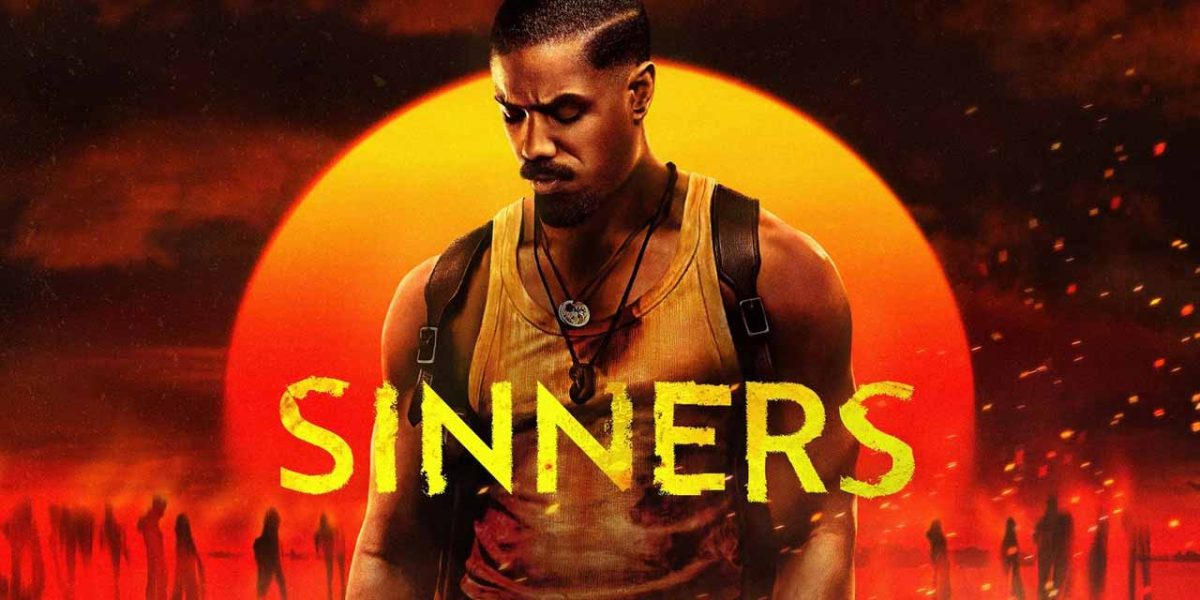
In March, Sinners won four Oscars: best original screenplay, best actor (Michael B. Jordan), best cinematography, and best original score. Sinners is one of my favorite movies, so I may be biased when I say I agree with all of these points, especially the music; it was amazing. But behind the incredible acting, terrifying legend of Remmick, and the slaughter of the people in the juke joint, there’s an even darker, true legend. The story of the King of Delta Blues, Robert Johnson.
Robert, born in May 1911, was the son of a family of sharecroppers in Mississippi. His father, hoping for a better life, brought his family to the Delta. Instead of working in the field, he played his guitar, likely leading to beatings and punishment like Sammie.
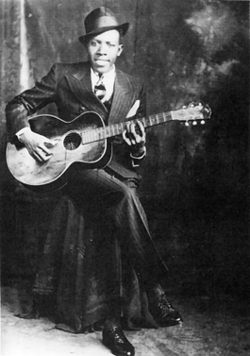
Getting married to his wife and getting her pregnant, he stayed back while she left to stay with her family, where she and her baby would die during childbirth. Heartbroken, he played more and more. While you’d expect him to gain a fanbase with how much he played, he accumulated a hate base. What he made was less of music and more of a ruckus. Often being laughed away or driving people out of the joint where he would play, he continued playing on street corners.
One mysterious day, Johnson disappeared. Nobody would see him again for 18 months, until he showed up one day at a juke joint with a mysterious 7th string added to his guitar. When he started, he didn’t just play the guitar, he turned the guitar into a vessel from the future. His performance sounded like a full band containing rhythm, melody, and vocals all in one. This is partly due to his use of open tunings and how he’d play, but how did he — the nobody from the Delta, suddenly make the guitar work for him?
His quick mastery of music and the guitar made people wonder; that’s when the theory of the crossroads would begin. One night, Johnson would stay at a crossroad (crossroads are seen as supernatural because they are a sort of “in-between worlds” where demons lingered) and meet with the Devil, where he’d trade his soul for talent, which correlates to how Sammie left the church and his family to play blues.
It’s said that instead of selling his soul, he left to be mentored by Isaiah Zimmerman, a notable blues player. The myth of the Devil likely came from Zimmerman and Johnson practicing day and night at cemeteries, where they had an audience that couldn’t laugh them away. This is the primary theory his surviving family pushes, saying the theory that he sold his soul discredits the talent, love, and effort he put into blues.
Johnson however, fed into it. With song titles such as “Me and the Devil Blues” and “Hellhound on my Trail,” it’s not hard to believe the theory he sold his soul. His lyrics are even darker, often singing about secular themes: “Me and the Devil was walking side by side,” “I’m going to beat my woman until I am satisfied,” “So my old evil spirit can take a greyhound bus and ride.”
If you listen to his music, you can hear the influence he had on modern-day music, with many artists such as Bob Dylan, Eric Clapton, and even bands like Fleetwood Mac, Led-Zeplin, and The Rolling Stones. You can hear the “full band” people talk about and you can eerily hear a modern-sounding guitar in the small clump of music he recorded.
As quickly as it started, it ended, with Johnson dying at 27, giving birth to the 27 Club. Like the rest of his life, it’s unknown how he truly died. Two running theories are that he was poisoned for sleeping with a man’s wife or simply died from syphilis.
Today, his legend lives on. Sammie and Robert Johnson’s correlation is unmistakable, showing the impact Johnson had on not only music but all forms of art. Now, the question of if Johnson really sold his soul will likely forever be a mystery, but don’t let it undermine how much talent he has and the effect he had on music. However, in this author’s opinion, how cool is it that the Devil could’ve played a critical role in today’s music?